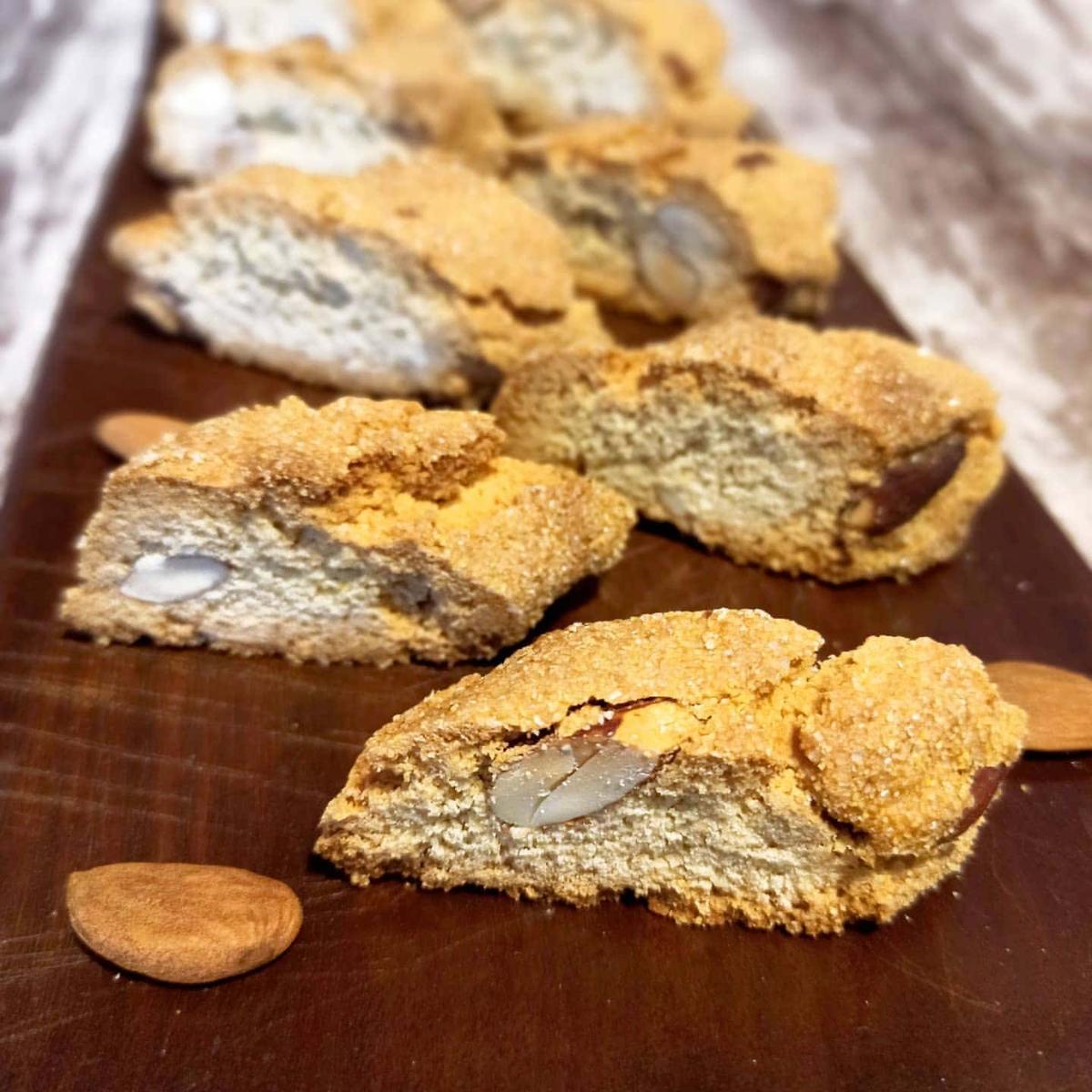
A happy discovery: crunchy, crumbly and suitable for those avoiding gluten
Rice and oat cantucci with almonds (gluten-free)
This recipe was a very pleasant discovery. We first tried it to use up several kilos of rice flour, out of the narcissistic and slightly masochistic pleasure of hunting down moderately unusual ingredients (oat flour – which isn't actually that unusual and reminds me of the fantastic oat frumentini – but above all amaranth flour – which I haven't been able to find anywhere for some time), and because we wanted to have a recipe 'on hand' that wasn't esoteric (meaning it didn't require overly unusual ingredients) for friends with gluten intolerance. We immediately appreciated its slightly unusual flavour and its 'crunchy yet crumbly' texture: you don't need steel molars; simply rest the biscuits against your incisors to start enjoying them. The almonds we use arrive vacuum-packed from Sicily, and the eggs come from Piedmontese farms,
The recipe
Rice and oat cantucci with almonds
| 350 g | rice flour |
| 200 g | cane sugar |
| 150 g | oat flour |
| 150 g | unpeeled almonds |
| 50 g | amaranth flour |
| 3 g | baking soda |
| 2 pieces | egg |
| 2 pieces | egg yolk |
| 1 pieces | lemon zest |
| 1 to taste | cornmeal |
| 1 to taste | salt |
Whip the butter with the whole eggs, the egg yolks and the sugar, using an electric mixer, until you obtain a fluffy mixture.
Add the rice, oat and amaranth flours and mix well.
Grate the lemon zest and add it to the mixture together with the almonds, the bicarbonate of soda and a pinch of salt.
Work the dough until it is compact.
Place the dough on a board and, with your hands, form it into logs (30×5 cm, h 3 cm).
Move the dough logs onto a baking tray lined with baking paper and sprinkle them with cane sugar and a little cornmeal.
Bake at 180 °C for 40’.
Let the dough logs cool, then cut them into cantucci 1.5 cm thick, let them air-dry for 10-15’, then bake them again for 10’ at 160-170 °C.
Remove from the oven, let cool and serve.
The recipe was taken from a well-known cookery magazine (published in the June 2016 issue) and can also be found on the website of that magazine, ‘La Cucina Italiana’
Various considerations
The first time I tried this recipe, I felt a bit like the manager of a smoothie bar (or whatever you call it) where Roberta once ordered a smoothie with two or three kinds of fruit (something like mango, açaí and carrot). The smoothie maker conscientiously takes down the order and goes back behind the counter. A few moments later, he returns and asks: 'But should I put in the mango, the açaí or the carrot first?' In fact, after reading the first step, probably out of professional habit, I wondered whether there was a particular order for whipping the butter, sugar, eggs and egg yolks, and what that order might be. Not wanting to experiment, I simply followed a tried-and-tested 'algorithm' from other recipes: cream the butter with the sugar until light and fluffy, then add the eggs (one at a time, waiting until the first has been fully incorporated before adding the second) and finally add the yolks (following the same procedure). There is probably a better or more efficient sequence, but given the result, and being rather lazy, I didn't investigate (I'm also a firm believer in the saying 'if it ain't broke, don't fix it'!).
I had another brief moment of uncertainty at the second step. Once again, I simply applied what I had already tried with other recipes: I put the flours, baking soda, salt and zest in a bowl, mix them with a whisk (which also helps justify my excessive collection of both bowls and whisks), then add everything to the butter, sugar and egg mixture. Finally, I add the almonds last.
Again drawing on other recipes, mainly because the dough is rather soft, I've introduced two additional steps (which slightly increase preparation time but don't make things more complicated). Once I've finished mixing the dough (and before dividing it into logs), I leave it in the fridge to cool and firm up for about twenty minutes. I find that after this time it's easier to shape the logs (after various attempts, my 'ideal number' is four logs for a baking tray of about 30×40). Before baking, I also put the logs back in the fridge for another 20 minutes or so: this seems to reduce the dough's tendency to spread out across the tray.
In general, rather than lemon zest, I prefer using orange zest or a mixture of the two (I also experimented with the zest of some fantastic mandarin-orange hybrids recommended by Marco – our fruit and vegetable supplier, whose produce is necessarily not all locally sourced – which I think gave the most interesting aroma).